Sunday, August 22, 2010

Home

Last Sunday, after 16 days in South Korea, I returned to Tokyo. And it felt good to be back in the city that, with the help of two quotation marks, feels sometimes like home. Now let’s be clear: Even 2-1/2 months into this whole new adventure, I know almost nothing about Tokyo. Were it not for an iPhone app with an interactive subway map, I suspect certain garden animals would be able to better-navigate the city. But I guess it’s sort of amazing, the way just a short time living abroad can reboot one’s standards for measuring familiarity. Even as I walked through the Haneda airport concourse, I got this giddy buzz. I knew how to order an iced coffee. I knew how to compute the drink’s price in US dollars. I knew how to find the bus that stopped at the Monorail. Even the particular Japanese mannerisms/verbal ticks that sometimes frustrate me — not worth explaining at present — in this moment seemed like welcome cues for Home.

So this is a blog entry about Home, and there are some positive developments here to report; just some. My apartment is pretty cool. Or rather, it’s cool when I have the AC on. While in Seoul, considerate of carbon footprints and all, I’d turned it off. This was only a bad idea because, just before my South Korea trip, buddy Jeff Passan had sent a care package containing several fire-log hunks of Vermont cheddar cheese. During my absence, this stockpile of cheese sat on the kitchen counter — in a smoldering apartment. And evidently, based on posthumous evidence, the cheese must have spent several days baking in its own heat. And I suspect it must have swelled. And swelled some more. And swelled some more, until at last mass deformities of molten cheese goop pushed through the wax encasement. And then the goop turned into actual liquid, maybe even making threatening popping sounds. And at some point — again, speculating — there was, perhaps, an actual cheese explosion. And magma fired everywhere. And the oily mixture of chedder and wax spread across the countertop and floor, dripping into the oven and dishwasher, finally hardening as a yellowish film.

Needless to say, it was a fragrant homecoming. I spent a good 45 minutes cleaning, fighting the oil but hopeless against the reek. My apartment smelled like a Cheez-It box.

Or it did, until the very next day. That’s when I received delivery of the furniture/kitchen supplies/clothing that I’d shipped (by sea) from Washington, D.C. before this whole move. Just to illustrate the underwhelming advances in transoceanic speeds since the Santa Maria era, I should note that I signed away these belongings to the moving company on May 27. Among other items, my sofa, several hundred books and CDs, and a panini press spent the entire summer on the high seas. And a summer at sea —I speak now from experience — has a way of making even the sleekest stainless steel panini press smell like a pair of gym socks.

Hmm… anybody want a grilled cheese sandwich?

I should reserve this paragraph, by the way, to express some gratitude. Seriously, God bless that unique Japanese gift for discretion. I’m talking, in particular, about the two gentlemen who lugged the 13 sea-weary corrugated boxes from their moving van into my apartment. They worked like champions, slicing at the duct tape, removing the various items, disposing of the bubble wrap, decompressing the emptied boxes into 2-D, and ultimately, introducing a second ungodly smell into what quickly became a 700-square-foot olfactory boxing ring. In this corner: Mildewed Gym Sock. In that corner: Molten 94-Month Aged Cheddar.

But here’s the amazing thing: The moving men, God bless them, they said nothing. Even the nonverbal cues — nothing. Pure valor. They finished with the whole unpacking job after about 90 minutes, and just before departing, they thanked me again and again — maybe ritualistic, yes, but there were at least five thank-yous. I could have donated a kidney and not gotten more sincere gratitude. When I finally closed my apartment door, I kind of hoped they at least had a good laugh in the elevator.

But now for the serious part of this blog entry. Because here’s the truth: Since that moment when those two fellows closed my apartment door, I’ve spent way too much time in the company of two smells and zero fellow humans. For three days this week — and this is painful to admit — I don’t think I had a single human encounter that didn’t involve work. Sure, I had a few of those 12-word interactions with baristas. And I said hello to the people at my apartment building front desk. And just to practice multisyllabic conversation, I conducted a few interviews via Skype with North Korea experts based in Seoul.

But this week it became quite clear to me that I still lack a social life here. I need to work at it. Hopefully, I can stay in Tokyo for at least another week or two and gain some momentum. The good news is, I had a fun weekend, and I spent some time with quality people. But the overall theme of this week, for me, was isolation: Isolation, coupled with all of its resulting neurosis. Without an office/bureau, helpless without the language, life can fast turn into a tiny echo chamber, and let me tell you, some ugly things can happen to the thoughts I deposit there: A sense of self-loathing, a sense of failure, a sense of being overwhelmed, and did I mention a sense of failure? I think, in part, these are rational thoughts: I am overwhelmed by my job. And it’s OK to be scared by it; indeed, fear is a potent motivator. But I’ve let these thoughts grow too large. Especially given the size of my apartment.

This morning, in a bold bid to avoid an honorary subscription to the Hikikomori Association Newsletter, I exited my apartment and went on a run. I followed a canal for about 8 miles, and though it was steamy outside I had lots of energy. In fact, I kind of felt terrific. I let my mind wander, and started thinking of goals — maybe a race in September or October. (I picture a two-hour road trip and a mountain. Now I just need to find the race, the mountain, and the language skills to locate either via Google.jp search.)

Anyway, just less than halfway through the run, I came across a baseball diamond. Two teams. Kids, maybe 8 or 9. The team in the field wore blue uniforms and called itself the “Rainbows.” Every child wore stirrups that stopped halfway up the leg, like mid-80s big leaguers. The Rainbows had at least seven coaches, stirrups similarly cropped, stationed along the foul lines and behind the backstop. Naturally, I paused my run and watched; you can’t pass this stuff up, a sniff of Home at “Home.” Five minutes turned into 10, and 10 turned into 20. I saw the Rainbows take two turns in the field. They looked pretty competent. The team fielding percentage, I’d guess, was around .640.

Just before I resumed my run, though, something sort of memorable happened. A batter scorched a ball between short and third. It skipped toward the left fielder — I was standing just behind the left field wall — and the poor left fielder, who’d been pantomiming his pitching wind-up for several minutes, let the ball roll past him. He had to chase it to the fence — a single turned into a triple.

And what happened next? Well, the poor kid, head down, heard his name called out by one of the coaches. And then — I swear, this never happened in Mt. Lebanon Little League — the left-fielder was pulled off the field. Replaced mid-inning. Tongue-lashed, with a firm lesson on keeping your glove to the ground, while some other kid stole his job.

At that point, I resumed my run. It was an out-and-back route, so after hitting the landmark bridge and U-turning again in the direction of my apartment, I passed the baseball field one final time. The chided left-fielder was back as his spot, to my relief, and I called to him, “Gambatte” (頑張って) — or, roughly translated, “Try your best.”

It was, I think, advice for both of us.

Monday, August 2, 2010

Control, or lack thereof

I begin today with a confession, and in turn, an explanation of what you’re about to read. I realize that this blog, ‘til now, has given a misleading sketch of my life, filled as it is with actual stories of actual people, some of whom even engage in conversations with me. There might even be, in these stories, a glimmer of adventure — Mother Earth feeding memorable experiences from out of her very palm. And if you’ve gotten this impression, I attribute it to the fact that I haven’t yet blogged about the entirely un-glimmering things that consume 90-percent of my life, like taking special subway rides to buy cheese, and using the Internet to research Japanese haircut vocabulary, so I can finally beat my fear and go to a barber shop.

(A charming outcome, by the way. For reasons unknown, I never even put the barbershop vocab lesson to use. I just sat down in an empty chair, made a few snipping motions with my fingers, recited a quiet prayer and somehow ended up with a haircut identical to the one I've had, uninterrupted, for at least 8-1/2 years.)

For two months now I’ve been living in Asia, and I suppose there are two ways, both equally honest, to depict the experience. I could count for you the number of countries I’ve visited, the number of new foods I’ve tried, the number of improbable conversations I’ve had. (Such as: a Vietnamese man describing how two of his nine dogs were poisoned by a neighbor, so they could be sold to a restaurant for meat.) Or, I could count for you the number of times where, rather than hitting the streets to discover some great metropolis, I’ve found a nearby Starbucks, popped open my laptop and read preview articles about the Big Ten college football season.

There’s a push-pull, I think, when living someplace faraway. In many circumstances, you develop new routines, or even lose routines altogether. But in other circumstances, you fight for your old ones. To put it more simply: Lameness is a survival skill, or mine at least.

BUT — I do want to give myself a little credit. For far too long, I’ve cared way too much about control. In fact, the desire for control explains a large portion of my life. It explains the sports positions I most enjoyed as a kid (pitcher, goalie). It explains why I’m organized. It explains why I’m risk-averse. It explains why I’m a good driver. It explains why I look at nutritional labels. It probably explains why I like not only marathons, but also the training. It almost certainly explains my career choice, because I love nothing more than sitting down in front of a computer, reporting already completed, and somehow converting information into a story. (Or at least trying to. Either way, it’s a process in which the writer is entirely dependent on his/her own devices.)

Oh, but I’m already losing track of things here; let me explain why I started the previous paragraph with an allcaps BUT. I did that because, as I am now proud to announce, the control-crazed, centerfield-hating, passenger’s side-averse Chico has been purged from the universe, and this is by design. I took this job for a lot of good reasons, and I had plenty of time to think them all through. But a small part of it was the desire to change things a bit — to force a personality shift, because I felt like I needed it. So far, it’s working out just fine. Maybe even better than fine. It turns out, I can get the same ol’ haircut without even having a say in the matter.

Months before arriving in East Asia, I read a great book by one of my favorite writers/journalists, Peter Hessler. The book is called “River Town,” and Hessler wrote it while spending two years, during his mid-/late-20s, working as an English teacher in Fuling, China. I have to paraphrase, because I don’t have the book with me at the moment, but Hessler wrote something the lines of this: When you live in a foreign country, you have to let go a little bit. You give up control over your own life. And to an extent, you just have to trust others.

I was reminded of this yesterday, when I went on a harebrained journey through Seoul in search of flu medicine. My recent sickness, which developed about two days ago — chills, fever, etc. — is even more troubling because I was already sick. Indeed, I developed the first symptoms of a cold on June 24. (I remember the exact date for reasons not worth elaborating on here.) At the time, my colleague Blaine Harden was still around, and when I mentioned to him my developing cold, he recalled for me the experience he had at the beginning of his stint in Asia, when he caught a cold that lasted for four weeks.

This sounded improbable to me at the time — that is, until my cold symptoms lasted for five weeks. Then, just as my congestion was finally clearing up late last week, I flew from Tokyo to Seoul, and whatdaya know, I suddenly needed a whole new kind of medicine in a country where I don’t even know the word for medicine.

It’s all a bit difficult to take, because as a kid, I probably got sick a grand total of three times. Once, it was the chickenpox. Twice, I just wanted to hear some yodeling music coming from nine-double-oh-three-six. So yeah, perpetual sickness is a new thing for me. I suppose one’s immune system, like one’s personality, takes a little time to adapt.

Yesterday afternoon, before attending a press conference at the South Korean U.S. Embassy, I found a pharmacy. One man, maybe 50 years old, stood at the counter — a barricade separating customers from the stockpiled pharmaceuticals. I asked the man if he spoke English, and he provided a convincing argument, using silence, that he did not. I then pointed to my forehead, pretending to dab it. I gave him a mock shiver. He nodded, and pulled something from the shelf. He held two fingers, then three, and it occurred to me that he was informing me not about price, but about how many pills to take, and when.

So I nodded, and said thank you.

But then he shook his head, and held up one finger, then three. And then he double-checked the box, this time flashing three fingers twice, like a catcher calling for a forkball.

I paid and decided that I’d just pop two pills in my mouth, hoping for the best.

I felt better.

Saturday, July 17, 2010

Vietnam

It's been a while since the last blog entry, and just to make up for the inactivity, I figure I’ll use the first sentence here to satisfy the July quota for adverb use, by saying that I’m just about to depart Vietnam, and I really really really really really don’t want to leave. I haven’t even boarded the flight back to Tokyo, and already I’m scheming to come back. I saw zero pagodas, zero rice paddies and zero rivers, so long as we’re discounting flooding alongside the highways. One night, I tried a fruit that actually smells like a diaper, all fecal and plasticy, with just enough squish. One day, after a two-hour motorbike ride through industrial traffic, I got so dirty that the smog stuck to my face, hardening into scales. In fact, I think the dirt actually burrowed under my skin. Days later, Q-tips still return from the depths with payloads of black. Needless to say, I love this country. Also, I loved the fruit that tastes like a diaper.

Tuesday afternoon, I stepped out of the Ho Chi Minh City airport and met my translator/friend Luan Nguyen. I say ‘translator’ because, in the pursuit of all things journalism, that’s what he did. I say ‘friend’ because, during five days of rainstorms and great food and $7 hotel rooms, that’s what he became. We’d exchanged about 36 e-mails before my arrival, and in our final exchange, Luan told me to wait at the airport pick-up gate for a young guy with a pig graphic on his T-shirt. This turned out to be the only pig of the week whose various parts weren’t promptly wedged between basil and sprouts, rolled in rice paper and dunked in fish sauce.

Right from the beginning, Luan became a brotherly partner in our weeklong mission to report a good story about education in Vietnam. And for all the fun I had this week, he’s to thank. He’s 23, a recent Dickinson grad. He has a few free months to spend in his home country before a September return to the States, where he’ll begin a consulting job, so that’s the backstory. Last night — my final one in HCMC — he took me out to meet his girlfriend and four other buddies; we started the evening at a restaurant specializing in snail cookery and ended the evening at an outdoor picnic table, sitting as all Vietnamese tend to do on one-foot plastic kids’ furniture stools. And I gotta say, the whole experience was a blast; maybe even more than that. And it’s hard to describe why, because yeah, it was just a good night out, with the temperature just right and the drinks sweating. But it was also this feeling of optimism, of possibility, of being from there and still feeling so welcome here, and this morning when I woke up in the Socialist Republic of Vietnam — a country that bans access to Facebook — I’d received three friend requests from people who alter their IP addresses to circumvent the block.

(In an unrelated note, before accepted said friend requests, I brushed my teeth twice, because my breath still smelled like the diaperfruit.)

Given that this blog entry is already 500 words long, and clearly lacking in any purposeful direction, I should state here that I have no great realizations to share about my time in a developing country. In fact, I’m a bit nervous about saying too much of anything. According to Blogspot.com’s User Guidebook for Travel Blog Regulations, any resident of a fairly controlled country who returns from a trip to a fairly totally-out-of-freaking control country is advised to promptly blog about something important, using phrases like “new appreciation” and “hidden beauty,” plus maybe one or two others that satisfy the obnoxious quotient not just for July, but also for August and September. But I’m sorry. I can’t do it. During the last five days, I’ve had a lot of weird thoughts about how to measure fortune and privilege, etc., and it’s particularly poignant because I now live in a country where the trains run on time, where the water is OK to drink, and where the toilets sometimes operate with automated touch screens. And here I am now in a country with such obvious misfortune, where the average person earns about $1,000 USD per year, where fires burn for no explicable reason, where people push dusty street carts along the highway… sometimes against traffic. Witnessing the squalor in such proximity — and with such contrast to your familiar settings — cannot help but set off a lot of profound questions, none of them original to me. But for now, I’ll just say this: Even countries where the trains run on time have their problems. Even countries where the street carts run against traffic have their delights. I could absolutely live in either sort of place, so long as there’s a grocery store that stocks breakfast cereal.

Vietnamese traffic actually deserves a full blog entry by itself, but I’ll settle for an abridged version. Here are the basic things to know. In Vietnam, almost everybody owns a motorbike. Almost everybody, too, owns a keen skill for ignoring traffic lights, stop signs, and other explicit guidelines designed to limit extreme danger. People wear helmets, but according to Luan, they are traditionally tested by being dropped once on the ground, from waist-level. If they do not crack, they pass the test for structural integrity. Kids 12 and under need not wear helmets. From what I observed, full families of four sometimes ride on these bikes. Sometimes with bushels of bananas bungee-corded to exposed engine parts.

When I first met Luan at the airport, we walked to the parking lot (filled with motorbikes), and there he asked me two questions. The first being, “Is this your first time in a developing country?” (No, it wasn’t.) And the second being, “Are you ready for the ride of your life?” (Umm, umm, umm, hand me the helmet.)

Thusly helmeted, we navigated Vietnam for the next several days. This was not altogether advisable, especially given the driving distances (far) and the weather (lousy). In a later moment of reflection, Luan admitted he pushed his motorbike to limits never before tested. But a note to my mother: Our helmets were of sound structural integrity.

Tuesday afternoon, all for the goal of an interview in a rural town 80 km away, we headed out of HCMC carrying little more than two backpacks, some bottled water and some mosquito spray. The first few kilometers were pretty fun. Luan, of course, did the driving. I mostly did the sitting and looking at the driver’s neck. But step-by-step, road conditions worsened. We encountered traffic — like, 140,000-motorbikes-at-a-Springsteen-concert traffic. We witnessed the sort of road impediments that almost defied belief. Miniature Mississippi Rivers alongside the highway. Detours that led over gravel, through potholes and under rope. (It was designed to keep people out. People ducked under.) Then, as we entered an industrial zone, we encountered lots and lots of big vehicles representing companies that just sound aggressive: Trang and Cong and such. And their tires kicked up furious amounts of dirt. I’ve encountered circumstances like this before, of course, and there’s always been a solution. Wiper fluid. This time, I just tried to close my eyes.

I took two videos from the road. First, you can get a sample of the flooding. Second, you see the results of two hours on a motorbike. Watch below. It’s a little taste of my trip. Because I’ve saved you the smell, the taste is all good.


Friday, June 25, 2010

Agreement

In this blog's one-month lifespan (estimated), I’ve carefully cultivated its reputation as a provider of sporadic, arguably worthwhile content and, foremost, vast periods of silence. Trust me, I want to amend this. This webspace might straddle the line between Blog and Defunct Blog, but never shall it cross. At some point during each of the last 14 days, I reminded myself that I needed to update the blog. And at some point during each of the last 14 days, I started to write. The only problem was, a proper blog entry — some tale with dialogue and resolution and realization — requires a good hour of writing/thinking, and for me at least, an hour of thinking provides just enough time to briefly consider that what I’m writing is stupid. So almost every day for the past 14 days, I stopped writing, deleted everything, and moved on to other Internet endeavors, like downloading Entourage episodes in 23 seconds with super-super-high-speed Korean broadband access.

(Last week I was even gonna blog about Korean Internet speed. I decided not to.)

So a recap is on order. Since last Wednesday, I’ve spent four nights in Seoul, South Korea, and four nights in Okinawa, Japan — both for reporting trips. In Korea, I traveled to the demilitarized zone with colleague Blaine and took at least one grainy in-the-distance-picture of a North Korean soldier. One night, when South Korea played Argentina in a World Cup match, I joined 50,000 frenzied red-clad people mobbing streets, and though I was wearing blue, having packed a light suitcase, I still felt that warm buzz of communal spirit, and world was nothing but song and painted faces and twinkling eyes. This feeling sustained itself until about the seventh minute of the game, when it became apparent that Argentina was gonna kick South Korea’s butt.

If you’re curious, I’ve posted on Facebook a few photos from my first weeks here. Captions, which require additional work, have been categorically omitted. If you see a picture of food, or even something that looks possibly non-toxic, you can rightfully assume that I’ve eaten it. You’ll also notice one photograph of cash, tucked in an envelope. This merits explanation. South Korea’s currency is called the won, and a single won coin — such a thing exists — is so worthless as to be almost theoretical, like absolute zero. If you pulverized a penny into snortable powder and isolated one speck, it would still have greater value than the won. Thus, in Korea, you need about 17 pounds of cash just to buy coffee. My wallet has permanent stretch marks.

But I guess every new place offers its surprises, and I’m foolish to complain. These surprises often account for my greatest joys and delights. Just a few days ago, for lunch, I headed to a Seoul food hall. I came upon a glass display case containing heavens-knows-what, probably various pickled spicy bits of cabbage and seafood, and I asked a vendor for her recommendations. Maybe people just like a clueless guinea pig, but within 15 seconds the vendor called over a vendor friend, and then two more vendor friends, and soon about a half-dozen middle-aged Korean women were squawking, gesticulating, handing me free samples and arguing over what I ought to try. I thought, This never happens at Giant.

Another of the mundane pleasures: The Japanese street address system is so complex and nonsensical that, from what I can tell, nobody is eligible to drive a Tokyo cab until completing at least eight years of secondary education. Sometimes even that’s not enough. Tokyo cab drivers have 3-D GPS systems on the dashboard and thick street-by-street address books on the passenger’s side seat. It’s quite common, indeed, for cab drivers to unfurl these books mid-red light, inspecting page after page while making various contemplative sounds. Every so often, when heading to an interview, I’ll get into a cab, say hello, and hand the driver an address. And every time, I think to myself: Today’s the day my driver won’t really stress about it. But I’m always proven wrong. There’s a kindness, a paternal resoluteness, in Tokyo cab drivers, and observing it has become a daily delight. You hand them an address, and they care. They get lost, and they agonize for you. They apologize again and again, and they moan, and they show you their street-by-street map books, and they are working with you, not for you. They adopt your mission so fully, I sometimes think they’d continue looking for the appointed street address even if I got out of the car.

So far, I miss only two things, really — friends and cheese. Also, when in Korea last week, I missed watching the World Cup on Japanese television. You might surmise that an English telecast would be preferable to a near-unintelligible foreign broadcast. (You might surmise, too, that 3-1/2 weeks is plenty enough time to secure a new apartment!) But in both cases, you would be wrong. Watching soccer on NHK never, ever ever gets old. NHK, for its soccer broadcasts, uses a two-man booth. I don’t know the broadcasters’ names, but evidently they were selected for their razor-sharp diction, which they maintain even during scoring opportunities, when they talk faster than anybody on the planet. Let me tell you, it’s a symphony of mellifluous past-tense verbs.

Then, there’s the matter that Japanese people like to agree with one another. They relish consent and harmony. In America, our broadcasters argue and debate. Or one acts as the analyst, the other as the straight man/devil’s advocate. In Japan, this dynamic inverts, and the broadcasters take turns making salient points. Whoever is not making the salient point must, by rule, interrupt the other with sounds of agreement. I think this is my favorite part of the Japanese soccer telecast. Because all things come in threes, one broadcaster will make a statement, then another statement, then a final statement. And each time, the fellow analyst will bring himself to the brink of hysteria with agreement, climbing a ladder of harmony, saying things like (first) “Hai!” and (second) “Mnnmmmmm” and (third) “So-des-neeeeeeeeh!”

It never fails.

Statement.

“Hai!”

Statement.

“Mnnmmmmm!”

Statement.

“So-des-neeeeeeeeh!!!”

And by the end, it’s just a go-round of scrumptious, munchy-sounding Mnmmmms and Neeeeeehs, as if the broadcasters are feasting from a stack of chocolate-chip pancakes.

So that’s why I like the World Cup.

Now I’m returning to Tokyo, heading back from Okinawa. I’m on an airplane. I haven’t written much about Okinawa here, and not for lack of desire. (I’ll post my story, written yesterday, once it’s published.) Okinawa is the southernmost island in Japan, and the vibe is far different than what you see elsewhere in Japan. The businessmen wear Hawaiian shirts. There’s lots of pork and goya in the diet. The island has its own phrase, なんくるないさ, which has a distinct Bob Marley-ish don’t-worry-be-happy connotation.

In Okinawa I also made my first real Japanese friend. Her name is Wakana, and we spent parts of the last four days together. She’s a student at the University of the Ryukyus, and though she served during interviews as my translator, she also guided me around the island. By the end, I really admired the hell out of her. She’s adventurous. She’s energetic. She takes belly dancing classes. Even better, she told me about the Japanese equivalent to Netflix, which means I no longer have to download American television on iTunes. She honed her English during a year in the United States, when she attended classes in Durango, Colo., so we talked last night over dinner about what it feels like to go somewhere far away, about why it’s difficult and why it’s worthwhile. There was lots of agreement and consensus on this matter, but because were speaking in English I didn’t imitate any Japanese soccer commentators.

Saturday, June 12, 2010

Friday night

I really like the Japanese term for hangover. Futsukayoi (二日酔) — that’s the word. It’s an amalgamation of three characters, which, combined, translate literally to Two-Day Sickness. This nugget of semantic trivia isn’t necessarily important, and it isn’t even that pertinent to the purpose of this blog post, but it does lend a distinct clue about the Japanese vigor for intoxication. It also informs the general feeling of purpose one discovers in Tokyo at around, say, 8 p.m., when all of a sudden half the city is ducking into food stalls and izakayas and karaoke clubs, assuming a place in the murky, smoky, barely-lit underworld where fun nights begin. And this, more or less, is the starting point for my story about a Friday night out in Tokyo.

Just a few weeks back, before I moved here, nights out were predictable affairs; predictable in the best way possible. But now I’m in Tokyo — a fine nightlife city, and a city of 13 million people, and a city in which roughly 12,999,992 of those people are total strangers, not counting a Starbucks barista and my real estate agent.

(Still apartment-hunting by the way. Many frustrations there; I’ll blog some other day about rental properties.)

Anyway, the properties of nightlife, for me, have now inverted. I do not plan my nights, and I do not have any favorite spots to recommend, and there is not even a speck of predictability. Nights now begin like this: With a meeting in my hotel lobby, a friend of a friend who just finished his workday. With a ride in a taxi to a neighborhood I don’t know. With a busy street intersection, lights everywhere, and then a turn around the corner, and then a narrow staircase, and then a back booth in a yakiniku restaurant whose name I don’t know and probably never will know.

For about two hours, we drank beer and roasted pieces of raw meat over the coals on our table. And things actually got really fun. My buddy (I’ll call him Kazu) was sort of reserved at first, asking questions about Obama and British Petroleum and such, but based on very unscientific observation, Kazu can engineer quite a drastic personality change after 2-1/2 beers. Soon there were grand stories of Vegas trips and clubs, and I got the sense we were in for a futsukayoi sort of night.

So OK.

There were more drinks ordered, and another round of beef. He was doing all the ordering, but I told him I didn’t want the gentle foreigner treatment; please, I said, order the non-gaijin food. And so we soon we were presented with a plate of raw beef liver, eaten sashimi style, and then another jar of raw beef, served with a raw egg mixed in — a veritable porridge of FDA violations.

The night gathered a sort of momentum, and we left the restaurant. We found another open door, another establishment, and here we found two women, drinks in hand. They were cute, and they clearly welcomed our company. For about 15 minutes we talked as a group, and Kazu told them I’d arrived in Tokyo last week. On cue I offered up a few catchphrases in Japanese, and one of the girls remarked that I didn’t have a foreigner’s accent — a misjudgment I’m gonna attribute to the thumping music, and to the delightful Japanese tendency to be easily impressed. Kazu then told the girls that I’d just eaten raw beef liver, and when they squealed with delight it was just another reminder that Japanese women are remarkable, and that some jdate.com taboos actually work here.

After some undetermined length, one conversation became two, and I found myself nose to nose with a girl named Nozomi. Kazu nudged my elbow and said, “I’ll leave you two alone.” And so there we were, alone. In retrospect, it’s sort of stunning that we maintained a conversation, maybe even with some chemistry. Her English was even worse than my Japanese. But it didn’t matter. I guess the takeaway lesson is, being dumb and agreeable isn’t altogether the worst posture one can use for flirtation. She basically talked, and whenever she stopped talking, I weighed the context and either responded, “Yes,” or “Wow, interesting.”

Today’s work schedule required a super-early wake-up call, so around midnight, after a good hour of talking and drinks, I told Nozomi that I had to be on my way. There’s no other way to say it: Nozomi was extremely nice. I almost felt sorry for her. Could this conversation have had less depth? Maybe if she’d been talking to a furry woodland creature. But we exchanged telephone numbers and e-mail addresses, and on the way home, I sent her a quick note (in English) thanking her for a good time.

This morning she wrote back:

おはよ♪ こちらこそ きのうは ありがとう!
楽しかったよ
またお話しましょうね☆
お家 はやくきまるといいね!
希 NOZOMI

I needed about three minutes to translate the note.

What it means, imprecisely:

“Good morning. I should say, ‘Thank you for yesterday!’ It was a really fun time. We’ll have to talk more sometime, don’t you think? I hope you find an apartment soon.”

What it means, more precisely:

As of this morning, in a modest sign of progress, my cell phone now contains nine telephone numbers.

Monday, June 7, 2010

A trip to the gym

Monday morning, I took a trip to the gym. This story, like most trip-to-the-gym-stories — an understandably small subgenre of the expository form — actually begins a day prior, when I spent four hours in a six-hour span strictly eating things that looked light brown and crispy. I woke up Monday morning, then, with grease and duck fat pumping through my veins, thinking it might be a good time to sweat a little.

Since I last wrote, I’ve been reasonably busy. I’ve done several things that felt like 75-percent of a worthwhile blog post. I visited the Meiji Shrine, a nearby landmark with its own official English Web site. I continued my apartment-hunting. I started planning a reporting trip (for later this week) to Okinawa. Also somewhere in these last few days, coinciding with presumptions of my craziness, I developed the distinct suspicion that 1.) Japanese water smells different than American water, and that 2.) I now smell like Japanese water, and that 3.) when I go to the gym, my sweat smells like Japanese sweat. My diet might have some influence here, too, but that’s a story for another paragraph.

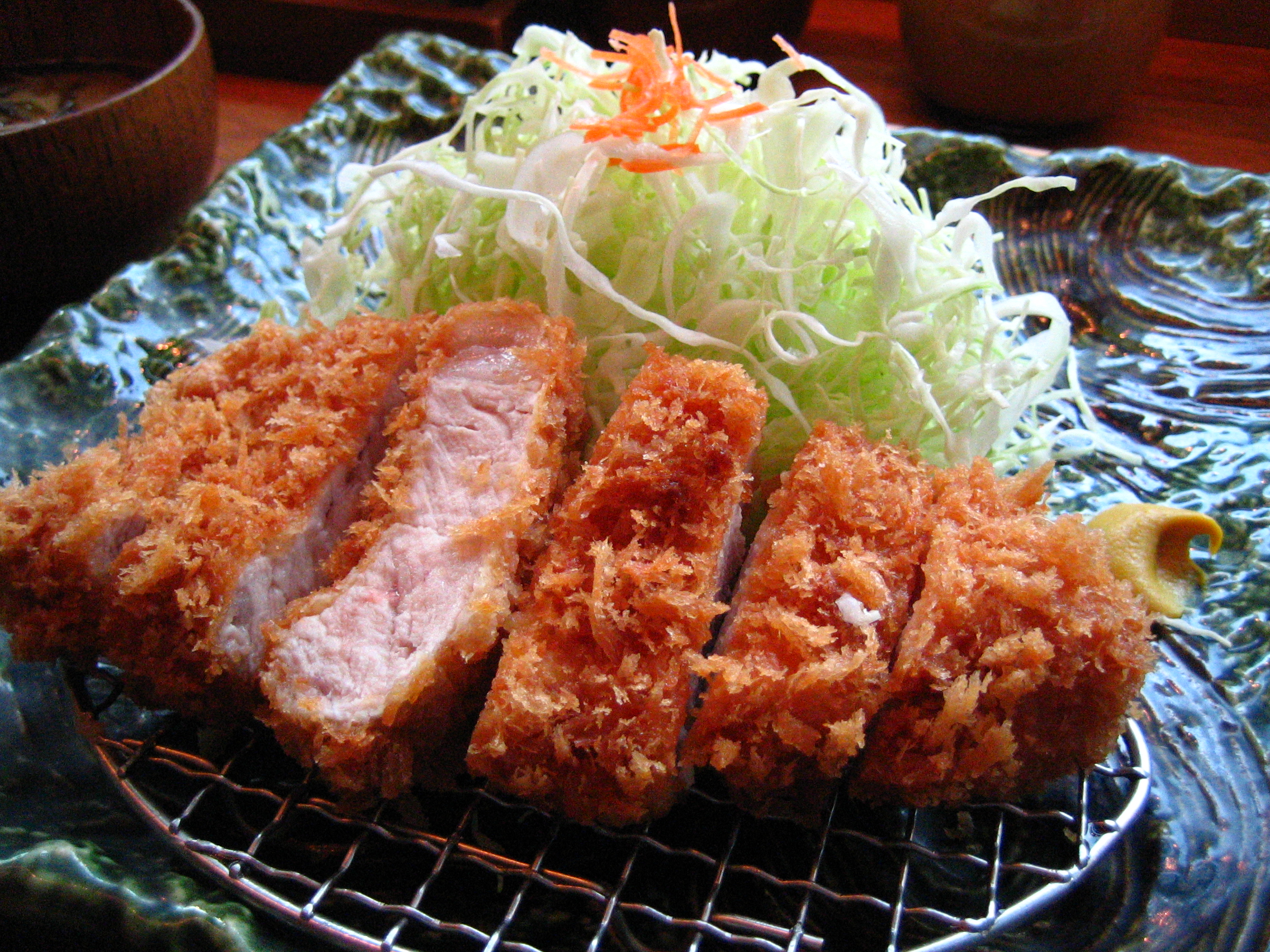
So let’s get on with another paragraph. Sunday turned out to be a good day, dedicated to social contact, fried food and a 10-year reduction of my life expectancy. For lunch, which actually lasted almost until dinner, I met up with two new friends — a local AP reporter and a British ex-pat who writes for a tech magazine. Together, we took a pilgrimage to a restaurant famous for tonkatsu, a Japanese-specialty — pork cutlet bathed in panko breadcrumbs and oil. The food was as grand as the company. I returned to my hotel at 4 p.m., spent two hours recovering oxygen flow, and promptly joined Washington Post colleague Blaine Harden for dinner. He’s an amazing journalist, and he spent much of the evening offering sage advice, starting even with his first suggestion, which had to do with dinner plans. He suggested that we head out for Peking duck.

Now, Monday morning.

Just about first thing after sunrise, I headed to a fitness center up the street from my hotel. My goal: Explain to the person at the front desk that I wanted to use the gym just once, and was willing to pay a small fee.

In the U.S., particularly while traveling the country as a baseball writer, I made these sort of transactions a habit, and never once did they amount to even 75-percent of a blog post. But in a place with a language barrier, every tiny exchange carries the sick, wonderful potential for disaster. There’s always a chance to you’ll wind up doing something abhorrently inappropriate. There’s also a chance you’ll figure it out, that you’ll do it right, and you’ll be proud and your heart will be pumping.

There’s an addictive joy in this, and I’m its junky.

Also sometimes its victim.

The fitness center straddled the 9th, 10th and 11th floor of a tall office building. When the elevator doors swung open, shooting me toward the gym welcome desk, I did something bold and stupid. I took out my iPhone and created a voice recording, just as a way to document what happens when one member of a conversation has the verbal skills of a toddler.

Please, have a listen.


You’ll notice that the conversation starts out fine enough, so long as we’re not deducting points for grammar. In polite Japanese, I say good morning. Then I make the requisite statement that my Japanese skills suck. (Girl at desk managed a smile.) Then, haltingly, I explain my life story. I tell her that I arrived last week in Japan. Lacking the capacity, I don’t explain why. I then hit her with two questions: First, if it’s possible to use the gym just once. And second, how much that might cost. We’re 21 seconds into this exchange, and it’s all good.

Then she mentioned the cost for one-time gym usage: Y 3,000.

You’ll notice that I twice recite the stated price, and that’s because my brain still moves slowly when converting phonetic sound into understanding. About five seconds after she explained the price, I realized that this one gym trip was about to cost me, roughly, $32.87. Which is not exactly a bargain, no matter how much duck fat you can sweat.

Given the freedom of English — at a Gold’s Gym in, say, Dallas — I would have hereby expressed my dismay with the asking price, and maybe tried some good-natured empathy to bargain for a deal. Maybe I would have backed out entirely, opting instead for a run around the city. But now that I’m in Japan, some decisions just get made for me. I’m fine with conversations that lead to a goal, but I’m not quite equipped for on-the-fly adjustments. So oh well. I handed her the bills.

Once I turned the voice recorder off, things only devolved. Turns out, Japanese gyms (or at least this one) don’t let you just walk in with any ol’ pair of shoes. They require all occupants to wear unsullied, never-touched-the-concrete “indoor shoes,” and just by chance rentals are available for an extra Y 300. Frankly, the poor gym girl from the welcome desk spent so much time trying to explain this to me, she probably deserved even more. After about two minutes of fitful measuring and calculating, we determined my Japanese shoe size (28) and uncovered a proper pair of snow-white New Balances. I was up to code.

So that’s the story of my trip to the gym. It was a thrill, and it was sort of educational, but in retrospect it was also a defeat. I paid $32.87, and all I got in return was a 60-minute workout, plus an unfortunate lesson that even gyms on this side of the ocean play Hoobastank music.

Thursday, June 3, 2010

The first full day in Tokyo

This is the sort of blog entry that I write with dread, and I say that only because I’ve been in Tokyo for 22 hours now, and I have nothing even close to a full thought or a final answer — just fragments and fears and joys, all warped by fatigue and caffeine. Whatever I write here, I’ll go back and read it someday and cringe. I’ll feel foolish. I’ll feel naive. But oh well. I’ll also look back on these first moments in a new country — 13 time zones and 5,000 Kanji characters removed from familiarity — as one of the weirdest chapters of my life, remembering all the sensations. It’ll probably be worth a good smile.

I’ll start with the part I feel most confident saying: The first day, including the trip here, was easier than I feared. In fact fear was the hardest part. Leaving DC was brutal; Monday night, I watched “The Hangover” with my closest friends, Eli and Rachel, and even that didn’t make me laugh. On the way to the airport, I listened to sports talk radio, 106.7 FM, and thought about how I might watch my next Super Bowl in 2014.

But attitude is truly a choice, and let’s be honest, this new journey is something I chose, and I chose it for many reasons. Even at the airport, I reminded myself to think about those reasons — to think about the upcoming adventures, the parts of the world I’d get to explore, the people I’d meet. My dad sent me an e-mail, subject, “As you embark on your new life…” and for the sake of his dignity I won't excerpt his metaphors (one involved a frog; another involved an elephant), mostly because the message was a great one. I actually boarded the plane with a smile.

The flight lasted 13 hours, one less than expected. As far as 13-hour plane rides go, I’ve never had a better one, and it was at least 160-percent better than my 16-hour flight to Australia.

I’d summarize the time thusly: There was 30 minutes of chit-chat with seat neighbor, followed by one hour of reading, followed by two hours of watching “The Blind Side,” followed by one hour of the “This American Life” podcast, followed by four or five hours of Advil PM-induced sleep, followed by two more hours devoted to Ira Glass, followed by another few hours of reading and chit-chat and eating. When we landed, I turned on my BlackBerry, learned that it still received e-mails, and promptly learned that Japan’s prime minister had resigned.

For a reporter, the resignation of a prime minister typically falls under the broad category of what we in the industry call “news.” This is true even in a country that disposes of its prime ministers as if they were decomposing produce. My intuition was to break through customs, grab my notebook, B-line to central Tokyo and write a breaking news story that landed hours later on A-1. Of course imagination, especially Advil PM-enhanced imagination, is always better than reality. The reality was, my outgoing colleague Blaine Harden had already written and filed the news story about six hours earlier. Tomorrow, I’ll cover the selection of Japan’s next prime minister.

So, now it’s time for the segment in this blog entry wherein the newcomer in a strange land gives his fresh-off-the-plane observations. (Ex: The heat is really dry in Las Vegas! And all the people smell like cigarettes and chicken drumsticks!) There’s probably only nominal value in these observations, and again, I’ll soon enough realize the folly of what I’m saying here. But that disclaimer out of the way, here’s my conclusion: This country would not work too well for Michael Oher.

Indeed, after a 90-minute bus ride from Narita airport, I arrived at my Shibuya-ku hotel, my short-term home while I apartment-hunt. The hotel room isn’t just smaller than what you get from an American hotel; it’s smaller than what you get from an American hotel as a complimentary fruit basket. The room’s desk chair, which is really just a stool, sits approximately 14 inches off the ground. Two of my four suitcases are lounging out of necessity on the bed. And the shower stall is tiny enough to create its own amusing dangers — namely, when some mysterious gust of air catches the base of the shower curtain, it takes on some distinctly cobra-like qualities, and I become its mongoose, just trying to avoid a slimy suffocation.

But let’s move on. More quick-hit Tokyo observations, mostly pleasant. The electronics don’t need converters. People drive with extreme care and politeness. It’s much quieter than I expected. There are lots and lots of beautiful women.

Last night, my first in Tokyo, I just walked around the neighborhood a bit. But today was my first proper exposure to the city. To mark the occasion, I rose from bed at about the time when I heard the first faint signs of street life. I was ready to go. Not just awake, but ready-to-lead-the-Second-Line-through-New-Orleans awake. It was 4:04 a.m.

So I started the day with a quick run through the mostly empty streets, eventually finding a circular public park for a few quick laps. At 9:30, I met the Washington Post’s full-time Tokyo-based assistant, Ako Yamamoto, who immediately showed herself to be the most competent, friendly, organized person I’ve ever encountered. If only the Diet knew about her, she could probably grab the prime minister’s seat.

Being in a new place always drives one, I suppose, to be more willing to give your trust to another. You have no choice, really. But Ako made it easy. With the help of a local realtor, we spent the morning on an apartment-hunting speed-chase, cabbing it from neighborhood to neighborhood. The routine basically went like this: We’d arrive outside some modern looking apartment, take the elevator up, remove our shoes and look around. Every apartment impressed the heck out me, to be frank. Once I settle on a place I’ll devote more blogspace to living arrangement details, but suffice to say I’m gonna be alright here. Oh, and when we used the metro, Ako handed me a pre-paid plastic card to swipe upon entering.

My mid-afternoon, I split ways with Ako and did a little more neighborhood strolling. There’s a special tension that comes during this — mostly established by the language barrier standing between you and your efficacy. Every little exchange, there’s the possibility of joy or embarrassment. I’m only slowly getting better at finding the courage to try. Today’s successes: Asking the front desk for an ironing board and ordering a coffee at Starbucks. Today’s failures: Follow-up conversations in said exchanges.

As a general rule, my best Japanese conversations end after somewhere between 15 and 25 syllables.

There’s plenty of space in a Japanese hotel room for my vocabulary.